Bret from YouTube channel SurvivalComms published a comparison of several EFHW transformers. He too found the Fair-Rite 2643251002 to be a superior performer.
My only critique is that back-to-back testing of transformers isn’t good for absolute testing of transformer loss. Testing this way includes mismatch loss that would otherwise be cancelled out by a tuned wire. The mismatch loss I’m referring to is like running a high SWR coax on your coax and exaggerates how lossy these are.
Core loss in with a FT240-43 toroid with 2 turn primary.Core loss in a 2643251002 toroid with 2 turn primary.
Bret’s testing is a good relative comparison though and his thermal testing clearly shows how lossy the common design on an FT-240-43 toroid is. I need to get around to some thermal testing on my 81:1 UNUN.
Having passed around my EFHW design for some third party testing I will say a high efficiency design isn’t for everyone. More thoughts on that in a future post.
81:1 UNUN with conductive metal eyebolt removed for testing.
TL;DR: The stainless eyebolt has such a small effect on the tuning of the transformer it can be safely ignored as a factor. For the full investigation into this question and why you should care, read on.
One of the things I’ve learned about EFHWs is they are rather sensitive to their surroundings, or at least the transformers are. The transformer is a tuned circuit performing a large impedance transformation. As a tuned circuit, it has resistive, capacitive, and inductive components. Ideally, the capacitive and inductive components cancel leaving a purely resistive load at the frequency of operation. Since this is a broadband transformer, we can’t adjust the capacitive and inductive reactances when in operation. Instead, we have to make a best effort to tune the transformer for optimal performance in our desired environment and then operate the transformer in such a way as to maintain that performance. Stray capacitance or inductance in our design may result in a less than optimal result.
So what does that mean? It means ensuring we do not introduce anything in the environment around the transformer that might affect the tuning.
My linked EFHW transformer design uses a stainless steel eyebolt to carry the tension between the support and the suspended wire elements. Mechanically, this is a great arrangement as it takes any lateral stresses off the polycarbonate enclosure and places them on a steel component that won’t bend, warp, or crack in extreme heat or cold.
The stainless eyebolt is very near the output of the transformer, however, so we can’t discount the possibility of it affecting the tuning and performance of the transformer. I’ve had it in mind to do some testing with and without the eyebolt to measure the effect it has and finally got around to doing so this past weekend.
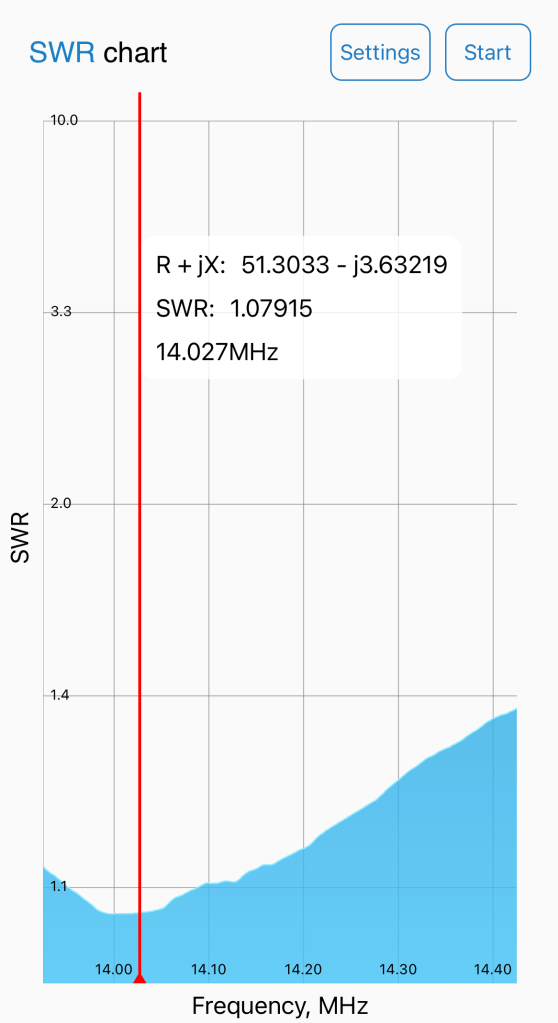
20m as-built results with eyebolt in place.
20m results with eyebolt removed.
Removing the eyebolt shifted the SWR null on the 20m band down 26khz. At this frequency, the result is inconsequential. Using the classic formula for the length of a halfwave antenna in feet as 468/f, we find the difference here is the equivalent of a mere 0.7″ of wire.
On 30m, the SWR null shifts only 12khz. As you move down in frequency the effect will eventually disappear. For the purposes of this project, a linked EFHW covering 80-20m, it can be safely ignored. On higher frequencies, however, it might be a factor.
Given the direction of the observed shift, it is safe to assume the eyebolt is acting as a small stray inductance in the system. In practice, stray capacitance is much more likely to be a problem while fielding the antenna. While I had the antenna up and hooked up to the analyzer, I measured this effect by placing my hand near the transformer while running a sweep.
Holding my hand near the transformer output shifted the SWR null almost 250khz!
Holding my hand near the transformer output shifted the SWR null a whopping 248khz. In our operating environment, there are many things that can cause the same effect. Wet trees or leaves, the earth, or a nearby metal building or roof can all have drastic affects on the performance of an EFHW. This is why I recommend keeping your EFHW transformer at least six feet away from nearby objects, especially when first tuning the antenna so you have a reliable baseline.
I am working on learning OnShape so I can design a 3D printed enclosure for my linked EFHW. The results of this testing are encouraging and will give me more flexibility in my design.
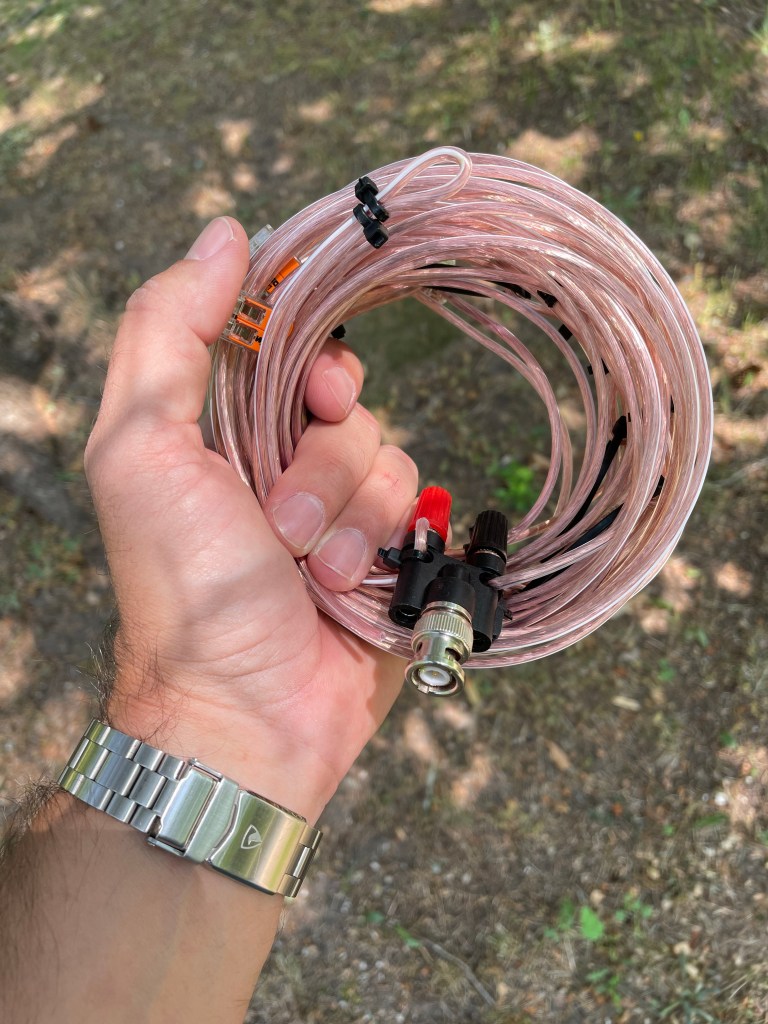
I’m travelling at the moment but need a WARC band antenna for TTP’s Anti-Field Day event coming up this weekend. I have individual antennas that cover 30m and could cover the other bands with a tuner but I decided to go to the hardware store and see what I could come up with. With some speaker wire, zip ties, and WAGO connectors I was able to put together a nice linked dipole to cover 12, 17, and 30m.
WAGO connectors and zip ties work remarkably well for a quick linked dipole.
This project was my first use of WAGO connectors. It was just happenstance that the local hardware store, Menard’s, had them. While familiar with them, I’ve never seem them in a store before. They probably aren’t the most durable solution but but they are small enough and convenient enough that I’m adding them to my radio possibles pouch for future improv solutions.
The cobra head and N9SAB nano BALUN are part of my normal portable radio kit so were already on hand to provide a feedpoint for this project. With the arborist throw weight and cordage from my EFHW kit I have a complete system ready for this weekend.
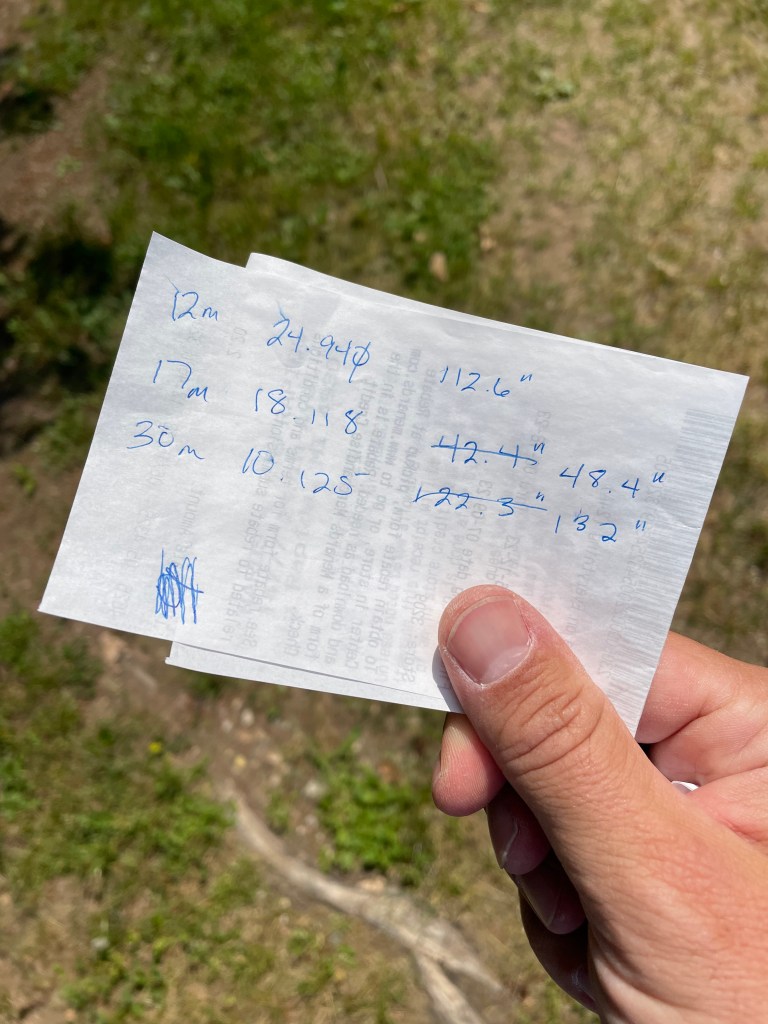
The whole project took about two hours to complete. It would have gone much quicker but I got cocky and decided to cut my elements right at 234/f after 12m ended up right on. It turns out 17 and 30m needed to be longer so those elements got cut twice….
My final dimensions for the WARC band linked dipole.
Hopefully this provides inspiration for your own projects.
UPDATE 15 August 2023: I’ve accomplished some testing to determine if the eyebolt used in this design introduces stray inductance or capacitance. Read about that testing here.
Starting in the fall of last year, I began working on a linked EFHW for portable HF radio. Almost all of my amateur radio activity revolves around portable ops. Parks on the Air (POTA) is a major interest as well as keeping my skills sharp for the unexpected.
As many portable operators have found, the EFHW is often the ideal balance of portable convenience and efficiency. I wasn’t satisfied with commercially available products, however, as I wanted an antenna with more control over the radiation pattern and a rugged build to match the needs of an adventurous field operator. Thus this project was born.
Rather than just copy existing designs, I made an effort in the project to further my understanding of the properties of EFHW antennas and use the latest build techniques and materials for improved efficiency. This effort builds on suggestions published by Evil Lair Electronics on YouTube, Owen Duffy, VK1OD, and Colin Summers, MM0OPX.
I’ve attempted to document all my findings in a comprehensive paper. The current draft is located in the Files section on this site. I still have a number of goals for this project so stay tuned for updates in the coming weeks and months.
I would very much welcome feedback on this project if you have suggestions for improvement or if you found this useful.





 The Orderwire